
July: Keeping Your Extra Virgin Olive Oil Alive Through a Heatwave
This month we are protecting our EVOO from the extreme heat and sharing tips on how you can do so too.
7/2/20264 min read
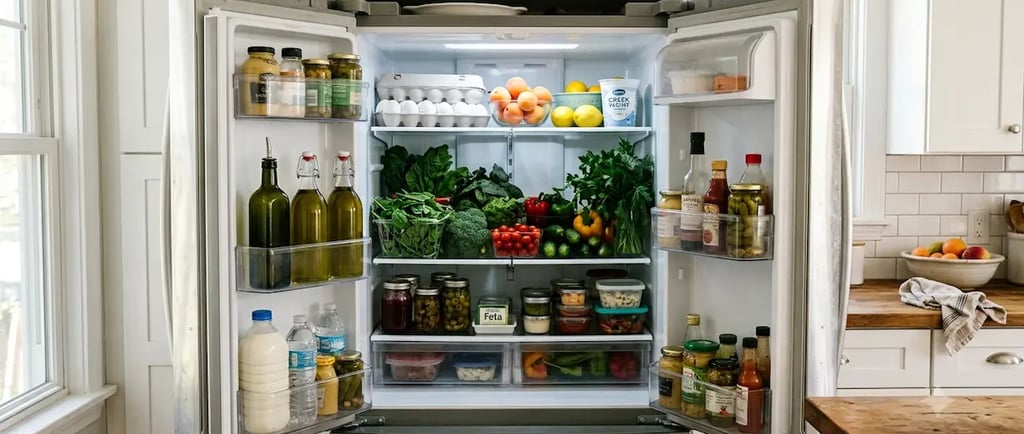
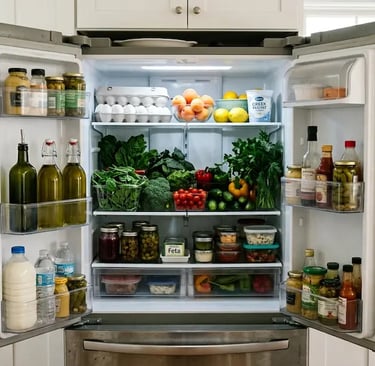
There's a set of rituals that mark the start of summer in Greece. The winter clothes get put away. The duvet comes off the bed. The carpets get cleaned and rolled up and stored until autumn. This year we added a new one to the list: putting the extra virgin olive oil in the fridge.
EVOO is a live organism, not just a liquid in a bottle. It's the pressed juice of a fruit, still full of living chemistry — phenols, chlorophyll, volatile aromatics — and from the moment it leaves the mill, that chemistry is changing depending on the conditions it's kept in.
This year we started a tasting course, which included tasting a whole range of oils – from award winning, fresh, to old and spoiled. Since then we've both got much quicker at picking up the signs of ageing — the muting of the pepperiness, the brightness dropping out of the smell and the flavour.
Summers in Greece have always been hot, but the heatwaves are getting longer and more frequent, and a lot of our customers are in homes across northern Europe that were never built with this kind of heat in mind — no shutters, no cool rooms, no air conditioning. A kitchen that hits 28 or 29 degrees for a week in London or Frankfurt suddenly becomes a hostile environment for the delicate EVOO, even if it never occurred to you that your kitchen could be hostile toward anything.
So here's what Nina actually does at home. The bottle is never next to the hob, never exposed to light, and she cleans the bottles meticulously before refilling them. She doesn't compromise on any of it.
If you have the space at home, buy roughly what you'll use before the next harvest.
We get through around 40 litres a year between the two of us — but that's Greek cooking for you. Among our EVOO enthusiasts and customers further south in Europe, 20 to 25 litres a year is more typical; further north, it’s more like 10 to 15. Buying in bulk at harvest time means you control the conditions the oil sits in from that point on — not the chain of suppliers, distributors, and retailers that get it onto a shelf.
Find the coolest, darkest spot you have at home.
A cellar, a basement, a pantry, a cupboard that doesn't share a wall with the oven — anywhere that stays cool and dark is doing real work. It might be convenient to keep the bottle by the hob, but heat and light are the two things that age EVOO fastest.
If you buy a 3- or 5-litre container, decant it into smaller bottles when you open it.
Each time we open a tin, we empty it straight into multiple bottles, so the oil isn't exposed to fresh oxygen every time we go back to it. Dark glass, stainless steel, or ceramic is best. At home we mostly use repurposed glass water bottles from the tavernas, to cut down on waste — they're clear, so we keep them in cupboards well away from any sunlight to compensate.
If you use a pouring spout, get one with a stopper.
Without it, air gets in slowly, and that's what causes oxidation and the ageing process.
Once the house goes over 25 degrees, the oil goes in the fridge.
If you have the luxury of a wine cooler, that's the ideal spot — 12 to 18 degrees is the range EVOO prefers, cool enough to slow down the chemistry without shocking it. A standard fridge works too – just keep it in the door, where the cold is less intense than at the back. We’ve read arguments that you should not keep olive oil in the fridge as condensation forms on the lid each time the bottle comes out of the cold which can get into the oil. To be honest, we need to research this more deeply to give a definitive answer, but we haven't found it to be a problem — we use a bottle with a stopper for daily use, so there's very little opportunity for condensation to reach the oil. Keep an eye on the thermostat and remove the bottle from the fridge once the temperatures in your kitchen get back to more reasonable levels.
If you're refilling a bottle, clean it properly first.
Old residue turns rancid and will taint the fresh EVOO poured on top of it. When cleaning bottles, we start with a drop of ecological detergent and hot water and let it sit until it cools down. Then we rinse with cold water until the bottle is clear from soap. If there are persistent marks or stains then we bring out the denture tablets! Drop one into the bottle, fill it with hot water leave it to fizz for half an hour, then rinse it again until the water runs clear. Allow the bottle to dry fully before you refill it with fresh EVOO.
Don't worry if fridge-cold EVOO turns cloudy or solid.
That's just the natural waxes and saturated fats settling out at low temperature — it isn't a fault, and it isn't permanent. Give it a few minutes at room temperature before you use it, and it will pour freely again.
Not everyone runs as strict a household as Nina does. I certainly couldn’t manage it. But even a couple of these habits, kept up through the hottest stretch of the year, will get you a good way closer to an oil that still tastes like the grove in October — which, if you've tasted EVOO that fresh, you know it's worth chasing.
the mighty olive
Premium extra virgin olive oil, farmed organically in Greece.
CONTACT US
JOIN OUR MAILING LIST AND BE THE FIRST
TO KNOW ABOUT OUR NEXT HARVEST
Nina: +30 699 307 6064
© 2026. All rights reserved.
Felicity: +30 697 266 3884
Registered Business Address: Antonia Foufa, Neromilos 0, Messinia, 24005, Greece
IMPORTANT LINKS